Dashboard
The Dashboard is the first screen you land on when you open Amazon Seller Sync. It answers three questions quickly: how much of your catalogue is connected to Amazon, whether anything is broken, and when the app last spoke to Amazon on your behalf.
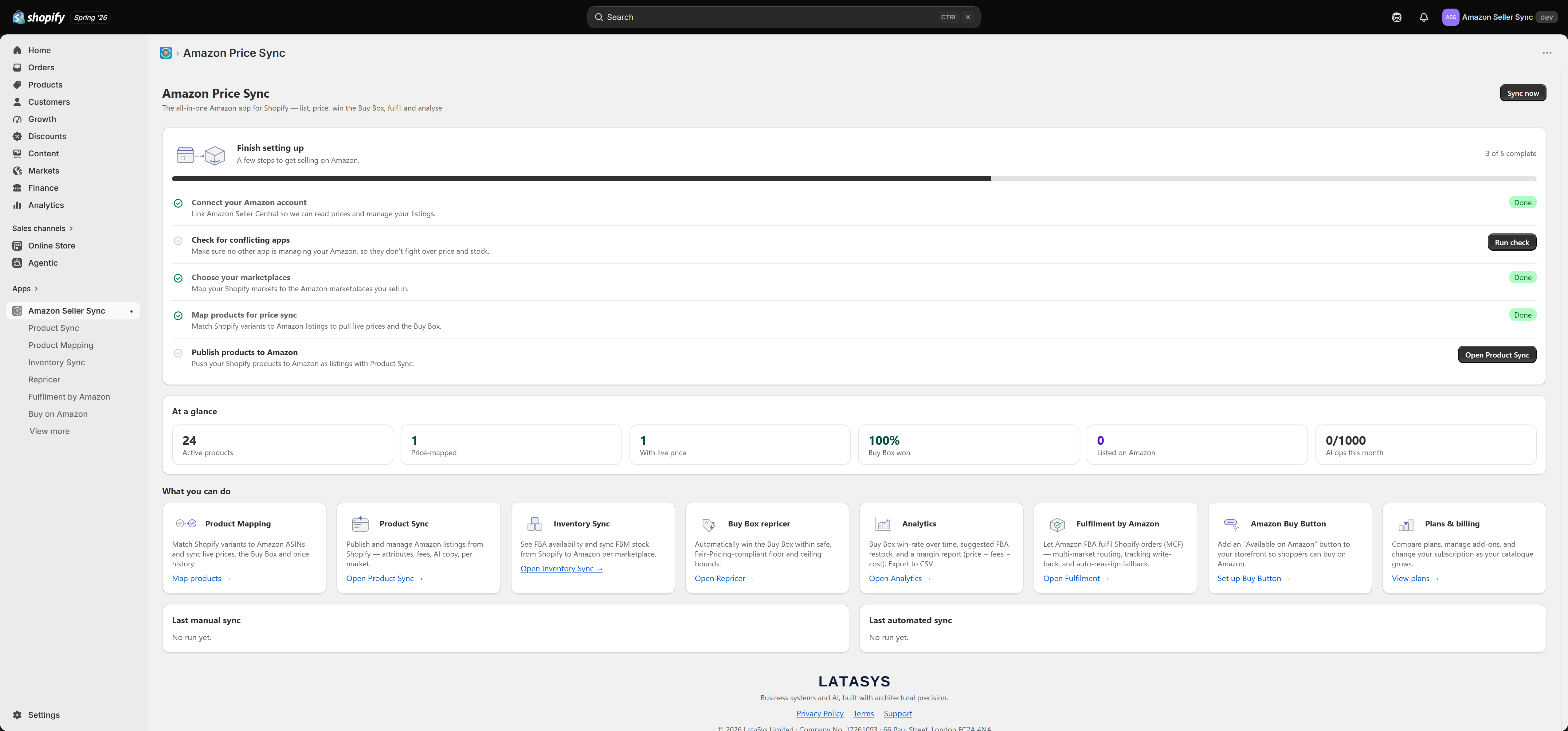
At a glance
The tiles across the top count your catalogue's relationship with Amazon. They refresh every time you open the page.
Active products is the number of active products in your Shopify catalogue, in other words the products the app considers eligible to work with. Drafts and archived products are not counted.
Price-mapped is the number of Shopify variants linked to an Amazon ASIN (an ASIN is Amazon's own product identifier). These are the variants that price sync looks up on Amazon. If this is zero, price sync has nothing to do and most of the app will look empty. You create these links on the Product Mapping page.
With live price is the subset of those mapped variants for which the app has actually retrieved and stored an Amazon price. It is normal for this to sit below Price-mapped, because a mapped variant only gets a price after the first sync run that reaches it, and because some ASINs have no New offer on Amazon at that moment. A large and persistent gap is worth investigating.
Buy Box won is shown as a percentage. It is the share of your mapped products that were holding the Buy Box (the "Add to basket" position on the Amazon product page) at the most recent reading. It is a headline number only. For the trend over time, use the Buy Box performance report.
Listed on Amazon is the number of products you have published to Amazon as real listings through Product Sync. This is not the same as Price-mapped. A price-mapped product is one you are watching on Amazon. A listed product is one you are selling on Amazon through this app.
AI ops this month shows how many AI actions you have used against your plan's monthly allowance, for example 12 of 50. The allowance resets each month. If you have added your own API key in Settings, your provider bills you directly and the cap does not apply.
Sync now
Sync now runs an immediate price sync across all of your mapped products, without waiting for your plan's scheduled run.
The button is disabled until you have connected an Amazon account. If it is greyed out, that is why. Connect an account under Settings > Amazon account and it becomes available.
When the run finishes, a banner appears reading "Updated {n} price(s), {n} skipped, {n} errors". Skipped generally means the app had nothing new to write for that variant. Errors mean the lookup failed at Amazon's end, and a large error count is worth chasing.
Tip
Press Sync now after mapping a batch of new products, rather than waiting hours for the next scheduled run to pick them up.
Sync health
Sync health is the part of the Dashboard most worth reading regularly. It reports on the state of your Amazon listings, so it only becomes meaningful once you have published products through Product Sync. It sorts them into three counts:
- Healthy: the listing is live on Amazon and Amazon has raised nothing against it.
- Warnings: Amazon has accepted the listing but flagged something, for example a missing recommended attribute or an image that falls short of its guidelines. The listing still sells.
- Errors: Amazon has rejected something. The listing may not be live, or may have stopped updating. These need your attention.
Below the counts, the card lists the individual problem items. It shows at most 8 of them, so treat it as a worklist rather than a complete audit. To see every issue on a given listing, open the product itself.
Each problem row offers three actions:
- Re-check asks Amazon for the current status of that listing again. Use it after a fix, to confirm the fix landed. Amazon can take a while to clear an issue, so a re-check immediately after a change may still show the old state.
- Re-push submits the listing to Amazon again from your current Shopify data. Use it when the fix was made in Shopify, for example you filled in a missing brand or description, and the listing needs resubmitting.
- Open takes you to the product detail page, where you can read the full Amazon issues & warnings list and see the fee breakdown.
When nothing is wrong, the card simply says "All listings are healthy". That is the good state, and it means Amazon is reporting no warnings and no errors against anything you have published.
For help decoding a specific message from Amazon, see Listing issues.
Last manual sync and Last automated sync
Two run cards sit below, and they are easy to confuse. Last manual sync is the last time somebody pressed Sync now. Last automated sync is the last time the scheduled sync ran by itself, on your plan's interval.
Read them together. If Last automated sync is stale, or blank when you expect it to have run, the schedule is not firing. The usual reasons are that no Amazon account is connected, that the app is missing a Shopify permission, or that your plan's interval is longer than you assumed. The read-only Automation tab in Settings shows the scheduled sync state, the schedule itself, and warns you if a Shopify scope is missing.
Finish setting up
Until you are fully set up, a five step setup guide sits on the Dashboard:
- Connect your Amazon account
- Check for conflicting apps
- Choose your marketplaces
- Map products for price sync
- Publish products to Amazon
Step 3 is the one that catches people out. It is only marked done when you explicitly save a market mapping under Settings > Markets. A marketplace the app inferred from your connected Amazon account does not count until you have saved the choice yourself.
Once all five steps are complete the guide shows "You're all set" and offers Hide setup guide, which clears it from the Dashboard for good.
If something looks wrong
Empty tiles, a stale automated sync, or a stubborn error count all have common causes. Start with Troubleshooting, and see Listing issues for the messages Amazon itself raises against your listings.
Related Articles
Mapping Shopify markets to Amazon marketplaces
Shopify has markets. Amazon has marketplaces. Settings > Markets is where you tell Amazon Seller Sync how the two line up, so the app knows which Amazon price belongs to which of your shoppers. There are two separate things on this tab, and they do ...Connecting Amazon Seller Central
Connecting your Amazon Seller Central account is the first step in the setup checklist, and it is the one thing every other feature depends on. Until an account is connected, price sync has nothing to read, Product Sync has nowhere to publish, and ...Getting started
This page is the whole first-run journey in one place: install the app, choose a plan, then complete the five step setup checklist that takes you from an empty screen to live Amazon listings. Each step has a detailed article of its own, linked below. ...Price sync
Price sync is the heart of Amazon Seller Sync. For every variant you have linked to an ASIN on the Product Mapping page, the app asks Amazon what that product is currently selling for and whether you are winning the Buy Box, then writes the answers ...Amazon Seller Sync
Interactive walkthrough Prefer to see it in action? Open the guided walkthrough, an animated, click-by-click tour you can play automatically or step through yourself. Amazon Seller Sync is an embedded Shopify app that joins your Shopify store to your ...